
Mines Predictor App
Mines Predictor by PredicGame combines automatic result collection with a configurable prediction panel, allowing users to observe game outcomes, study statistical patterns, and experiment with different algorithm settings.
Automatic Operation
Automatically retrieves Mines game results from the server.
Free
All collector and predictor features are available for free.
Flexible Algorithm Settings
Adjust model parameters and experiment with different calculation methods.
Real-Money Play
The Mines Predictor only works in real-money game mode.
What Is Mines Predictor?
The main purpose of Mines Predictor is not to promise guaranteed wins or claim that it can determine the exact location of every mine. Instead, it provides a practical environment for conducting your own experiments, collecting data from completed rounds, and evaluating how different analytical models behave under various conditions.
The Mines game involves selecting cells on a grid while avoiding hidden mines. Each round produces an outcome based on the game’s random generation system. Mines Predictor collects relevant round data and uses it as input for its analytical algorithms. Depending on the selected settings and the available history, the application generates suggestions that can be compared with actual game results.
Mines Predictor is a free experimental tool from PredicGame. Its purpose is to help users explore data and test analytical methods rather than present gambling as a reliable source of income. The quality of the collected statistics depends on the available data, the selected settings, and the number of completed rounds.
| Version | Date | Changes | File Size |
|---|---|---|---|
| Mines_Predicgame_0.1.0.apk | October 30, 2026 | Predictor app for the “Mines Stake Original” game | 0.765 Mb |
Mines Predictor Interface
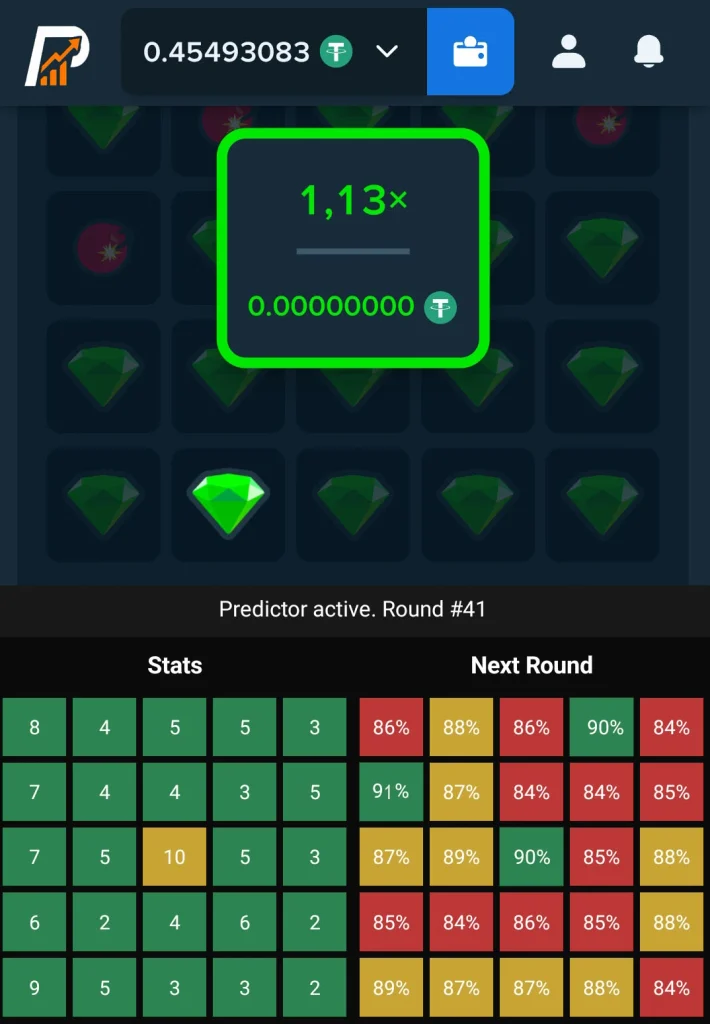
The application is designed to combine the Mines game and the predictor in one convenient interface. The game occupies the main viewing area, while the prediction panel provides access to analytical information and the controls needed to conduct experiments.
The exact layout and available functions may vary depending on the application version.
Game Window
The upper part of the application displays the supported online Mines game. Users can interact with the game, select cells, start new rounds, and observe the actual outcomes without constantly switching between separate applications.
The supported game depends on the installed version. For example, version v1.0 is designed for the Mines Stake Original game. Before starting an experiment, make sure that the game opened in the application is compatible with your version of Mines Predictor.
Prediction Panel
The prediction panel is located at the bottom of the application. It displays the algorithm’s recommendations and provides access to the controls needed to test different configurations.
The panel includes the following elements:
- Information Bar — displays key information about the predictor’s current status.
- Mine Heatmap — a 5×5 grid that displays statistics on how frequently mines have appeared in specific cells based on the collected data.
- Prediction Grid — a 5×5 grid that highlights the cells recommended by the algorithm for the next move.
- Settings — provides access to the predictor parameters that can be adjusted during experiments.
The cells highlighted in the grid on the right represent the algorithm’s recommendations for the next move. They are not guaranteed to be safe, and the application cannot guarantee that these cells will be free of mines in the next round.
Settings Menu
The Settings menu allows users to configure the predictor for their experiments. The available parameters depend on the installed application version and the algorithms implemented in it.
One of the most important parameters is the number of mines. It must match the number of mines selected in the game itself. For example, if the game is set to five mines, the predictor must also be configured for five mines.
Other available algorithm parameters can be adjusted to compare different configurations and observe how they affect the recommendations. Changing these settings does not affect the game’s random number generation process or allow the application to control the placement of hidden mines.
For meaningful comparisons, it is recommended to adjust parameters systematically and evaluate the algorithms using a sufficiently large sample of rounds rather than drawing conclusions from only a few results.
Mines Predictor User Guide
Mines Predictor User Guide
Follow the steps below to install the application, set up the game, collect initial statistics, and start testing prediction algorithms.
1. Install the Application and Open the Game
Download the Mines Predictor APK file for your device. Install the application on your Android device and launch it.
Android may ask you to confirm installation from a source other than Google Play. If prompted, allow installation from the source you are using.
Open a supported Mines game in the application’s game window. Depending on the casino platform and its version, you may need to register an account or sign in to an existing one before playing.
Follow the casino’s account and verification requirements. Read the platform’s terms and conditions before starting a game.
Mines Predictor is an independent experimental tool. It does not replace the casino’s systems for account management, payments, or game operation.
Mines Predictor is not intended to be a source of income. Its primary purpose is to collect game data and test analytical methods.
2. Select the Supported Mines Game
Open the Mines game supported by your installed version of the application.
Supported games may vary between application versions. For example, Mines Predictor v1.0 is designed for Stake Original Mines. Always check the version information and make sure you are using the corresponding supported game.
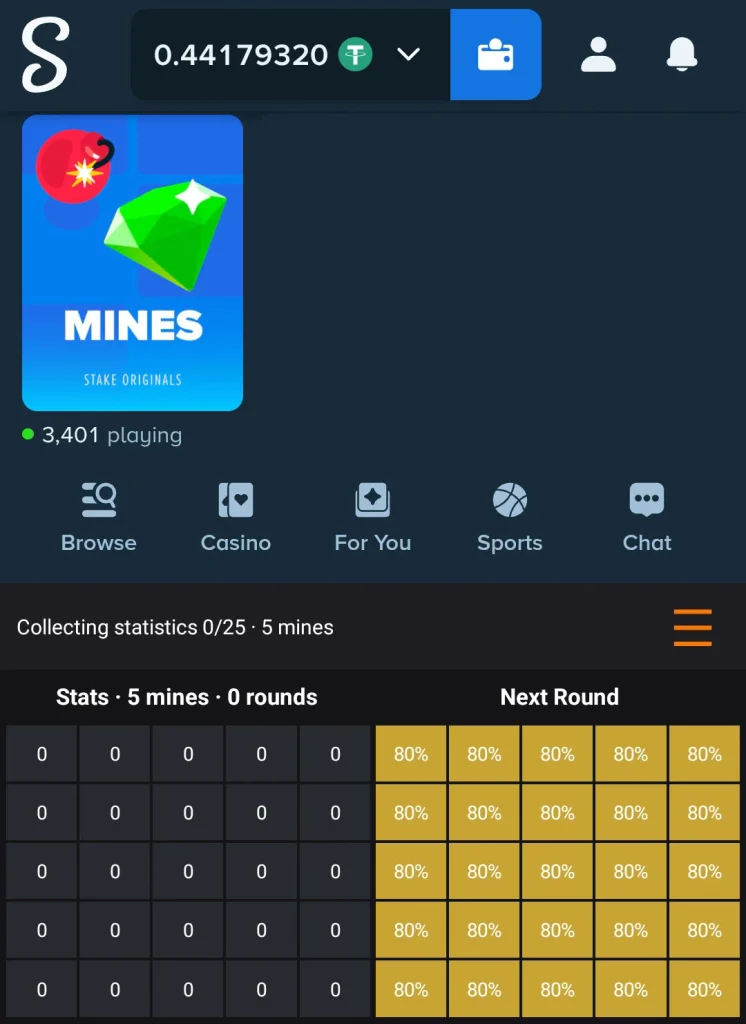
Different games and implementations may use different interfaces, data structures, or game rules. Using an unsupported version may prevent the application from collecting results correctly or make the collected statistics unsuitable for the intended experiment.
3. Set the Number of Mines
Select the desired number of mines in the game settings. Then open the Mines Predictor settings and select the same number of mines.
For example, if the game is configured to use five mines, set the Mines Predictor configuration to five mines as well.
The number of mines selected in the game and in Mines Predictor must match. If the settings differ, game results may not be received or processed by the application correctly.
4. Collect Initial Statistical Data
Mines Predictor requires an initial sample of completed rounds to begin evaluating its algorithms. The first 25 completed rounds are intended to provide the baseline statistics needed for the application’s initial analytical process.
During this stage, focus on collecting data rather than trying to maximize winnings. The application needs completed-round results to build its initial history and establish a baseline for subsequent experiments.
Use the lowest available bet and avoid opening multiple cells in a single round. Opening just one cell per round is sufficient for the recommended initial data collection procedure.
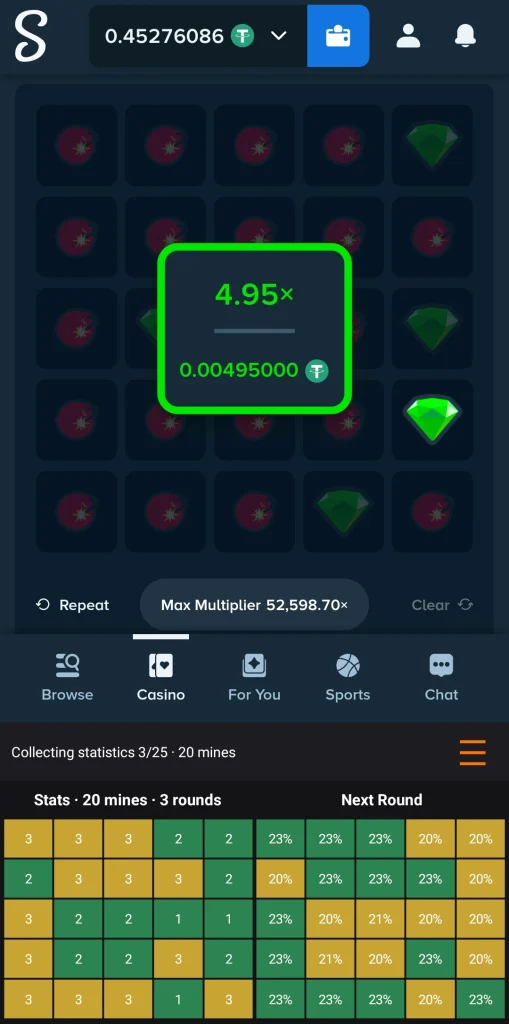
Recommended Procedure for the First 25 Rounds
- Set the minimum available bet.
- Open one cell and complete the round according to your chosen testing procedure.
- Repeat until 25 completed rounds have been collected.
- Check that the application records the results and updates its statistics.
The goal of this stage is to build a minimum initial dataset so the predictor can begin its analytical process.
As more round history is collected, the application has a larger dataset available for analysis. However, a larger dataset does not guarantee more accurate predictions of future outcomes.
5. Start Testing the Predictor
After collecting data from the first 25 rounds, you can begin experimenting with the available prediction algorithms.
Observe how the predictor evaluates cells, compare its outputs with actual game results, and continue collecting data during subsequent sessions.
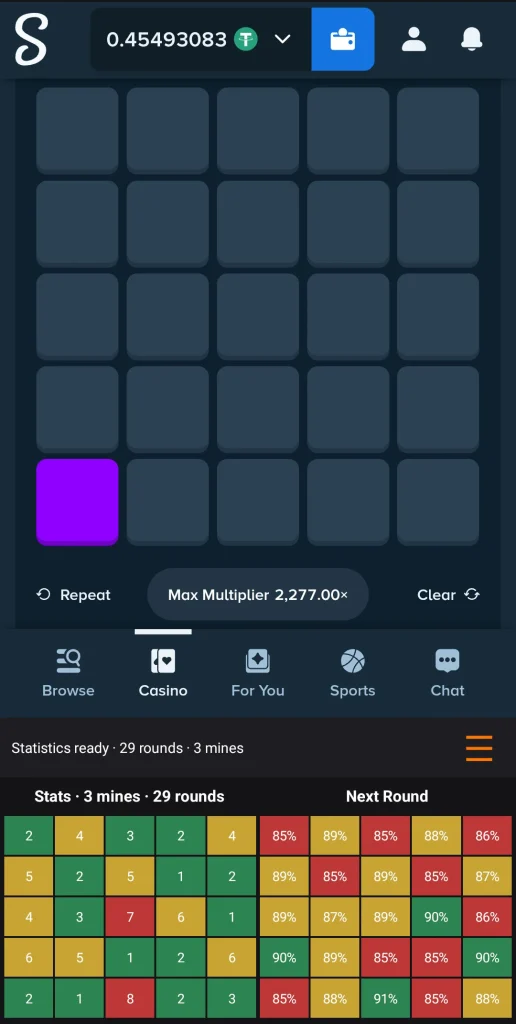
Treat the displayed ratings as experimental analytical estimates, not as guaranteed indications of safe cells. Historical results and algorithm outputs cannot guarantee the outcome of a future Mines round.
For meaningful experiments, evaluate performance over multiple sessions rather than drawing
How the Algorithms Work
Mines Predictor uses a cell-ranking system to assign each cell an experimental safety score from 0% to 100%. Each cell is evaluated individually before every new round, using recent outcomes and statistics collected during the current game session.
At the beginning of each calculation, a baseline value is set for each cell:
| Number of mines | Initial probability | Number of mines | Initial probability |
|---|---|---|---|
| 1 | 96% | 13 | 48% |
| 2 | 92% | 14 | 44% |
| 3 | 88% | 15 | 40% |
| 4 | 84% | 16 | 36% |
| 5 | 80% | 17 | 32% |
| 6 | 76% | 18 | 28% |
| 7 | 72% | 19 | 24% |
| 8 | 68% | 20 | 20% |
| 9 | 64% | 21 | 16% |
| 10 | 60% | 22 | 12% |
| 11 | 56% | 23 | 8% |
| 12 | 52% | 24 | 4% |
Let’s examine how the algorithm works with 3 mines, given a base value of 88%.
Cell Safety Rating
The application uses three color categories to display each cell’s current rating:
- Red (0–86%) — lower experimental safety rating.
- Yellow (87–89%) — intermediate experimental safety rating.
- Green (90–100%) — higher experimental safety rating.
The colors represent the algorithm’s calculated score, not a verified probability that a cell is safe in the next round.
Condition 1: Consecutive Rounds Containing a Mine
The algorithm increases a cell’s score when mines appear in that cell in consecutive completed rounds:
- 2 consecutive rounds: +1%.
- 3 consecutive rounds: +2%.
- 4 consecutive rounds: +3%.
This condition adjusts the cell’s score according to its recent sequence of outcomes.
Condition 2: Consecutive Rounds Without a Mine
The algorithm decreases a cell’s score when it remains free of mines for several consecutive completed rounds:
- 4 consecutive rounds without a mine: −1%.
- 5 consecutive rounds without a mine: −2%.
- 6 or more consecutive rounds without a mine: −3%.
This condition accounts for extended sequences in which no mine has been recorded in a particular cell.
Condition 3: Mines Recorded in 30–49% of Rounds
The algorithm increases a cell’s score by 2% if the number of recorded mine outcomes in that cell represents between 30% and 49% of all completed rounds in the current game session.
Condition 4: Mines Recorded in 50–100% of Rounds
The algorithm increases a cell’s score by 3% if the number of recorded mine outcomes in that cell represents between 50% and 100% of all completed rounds in the current game session.
Condition 5: Mines Recorded in 12–29% of Rounds
The algorithm increases a cell’s score by 1% if the number of recorded mine outcomes in that cell represents between 12% and 29% of all completed rounds in the current game session.
How the Conditions Are Applied
Each cell is evaluated independently. The algorithm starts with the baseline score of 88% and adjusts it according to the applicable conditions, using recent consecutive outcomes and the frequency of mines recorded during the current session.
The resulting score determines the cell’s color category and its position in the experimental cell ranking.
Important: These scores are internal algorithm ratings, not statistically verified probabilities of safety. Past results do not determine future outcomes, and a higher rating does not guarantee that a cell will be safe. The purpose of this system is to support statistical experiments and evaluate how the algorithm behaves over time.